

We conducted a study on the morphological and relief features of brown bear dens in the Velebit region to determine their locations, aspect, most common elevation, and other data. In addition, we carried out the first study of den microclimates in the Dinarides to establish the differences in air temperature and relative humidity between dens and their immediate surroundings.
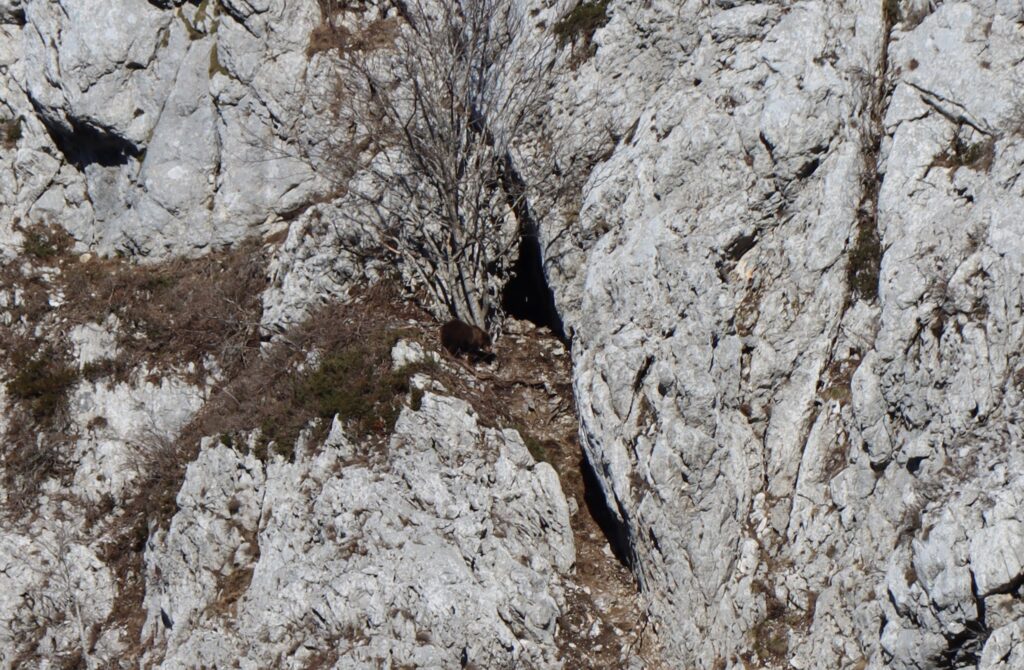
The den is a critical component of a bear’s survival because, during winter hibernation, it provides shelter with a stable microclimate, directly impacting the survival of cubs and, consequently, the overall stability of the population. To better understand dens,we conducted a research into their morphological and relief characteristics. We also investigated microclimatic conditions, marking the first time such a study has been carried out on Velebit dens.
A reliable den – vital for the survival of the species
Bears retreat to dens in winter, seeking remote and quiet forest areas. However, this rule applies primarily to females about to give birth, while males may remain active throughout winter if food is available. While in the den, bears do not tolerate disturbances; if disturbing incidents occur, the female may abandon the den and her cubs, which carries a high risk of cub mortality. Reliable dens and quiet surroundings are therefore essential for the species’ survival.
Velebit bears are not particularly picky—for denning, they can use small caves or rock crevices, standing hollow trees, holes among the roots of old trees and stumps, hollow logs, or excavated spaces beneath rocks. Nevertheless, small rock crevices are the most common, accounting for 77% of all dens according to our research. Given that bears prefer reusing the same dens, it is assumed that den quality is the primary factor driving their choice.
Dens are most common between 900 and 1,100 meters above sea level
The highest percentage of dens on Velebit is found at elevations between 900 and 1,100 meters above sea level, while the lowest percentages are located at 700 to 900 meters and above 1,500 meters. Lower elevations feature less rocky terrain, whereas higher elevations—above the upper limit of forest vegetation—lack forest complexes, both of which are key factors for a secure den. Furthermore, snow cover above 900 meters provides sufficient additional insulation for the den.
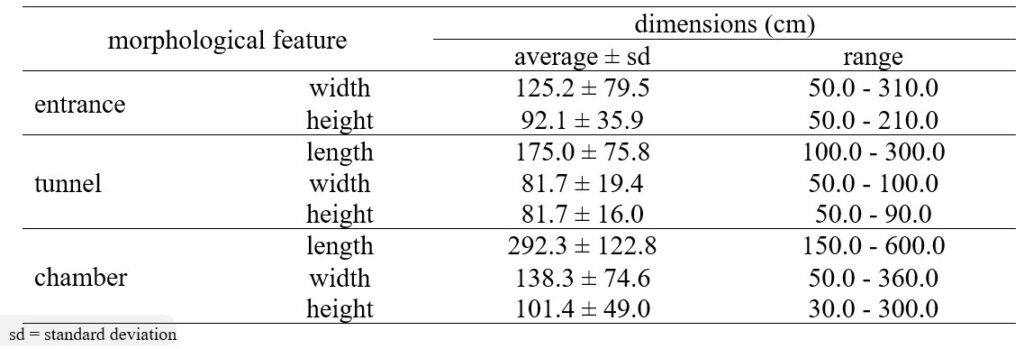
Two-thirds of the dens are located on slopes steeper than 25°, on very rocky ground (averaging 68% rockiness), and situated on the upper third of the slope—making them relatively inaccessible. An eastern or southern aspect is most common, as these slopes warm up faster, creating more favorable microclimatic conditions.
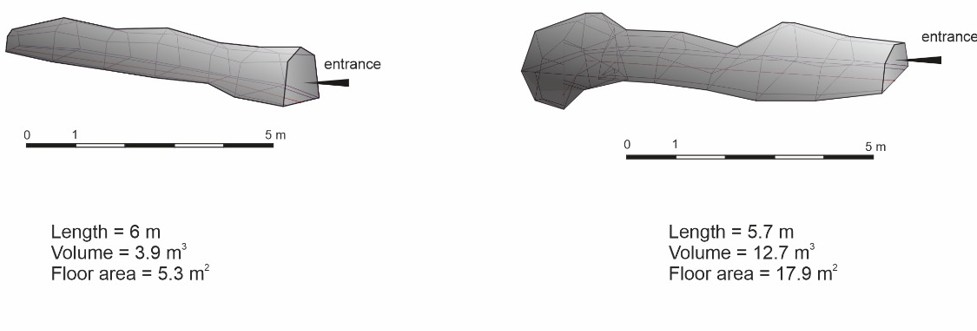
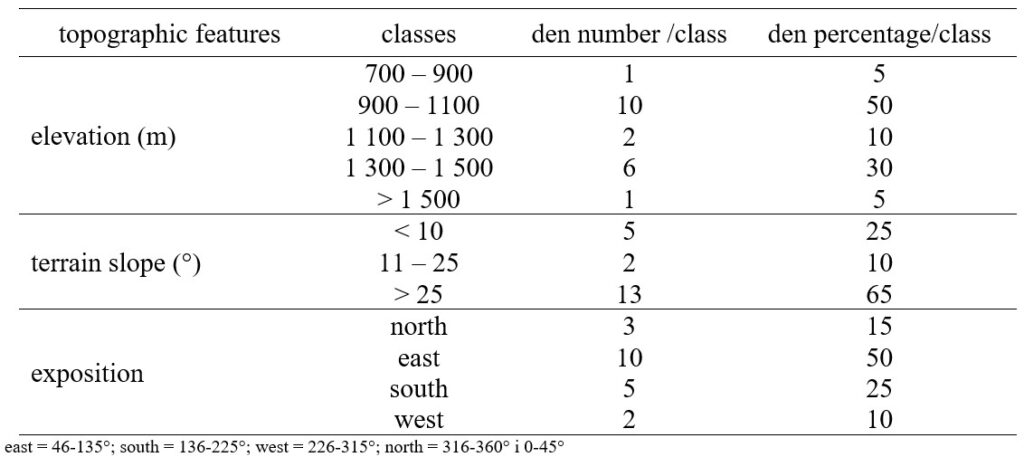
An average den features an entrance width of 125 cm and height of 92 cm, a tunnel length of 175 cm, and a chamber measuring 292 cm in length, 138 cm in width, and 101 cm in height. Sizes and shapes naturally vary, as shown in the chart. What has been reliably established is that in three-quarters of cases, bears choose rock dens, as they are the most durable and provide the best microclimatic conditions.
The first study of den microclimate
We also conducted the first study of den microclimates in the Velebit area, measuring air temperature and relative humidity inside the dens and comparing them against measurements taken in the adjacent forest. The study used temperature and humidity data loggers deployed for six months—installed shortly before denning began and removed after the bears emerged.
The research revealed that air temperatures inside the dens were higher than in the surrounding forest stands. Better conditions—namely more stable temperatures—were found in longer dens with a long tunnel and a small chamber at the end, particularly where tunnels had smaller widths and heights. The larger the chamber, the larger and shorter the tunnel, and the larger the entrance, the smaller the difference between the microclimate inside the den and its surroundings, making such dens less appealing to bears because they require more energy to maintain body temperature.
Distance from human settlements – at least 2 kilometers
During winter and autumn, temperatures inside the den were significantly higher than in the forest stand, with the exception of days with warm southerly winds. In spring, the reverse occurred: temperatures were higher in the forest stand than inside the den. Regarding relative air humidity, it was significantly higher in all dens compared to the surrounding forest stands.
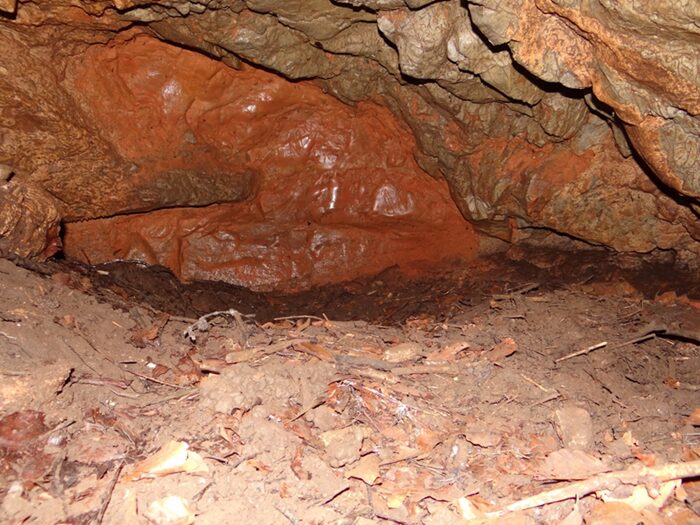
Bears select isolated areas far from human presence for their dens. While complete isolation is not always possible, research confirmed that a certain buffer distance exists. The distance of the observed dens from human settlements ranged from 2 to 4 kilometers, while the distance from forest roads ranged from a minimum of 20 meters up to 2.5 kilometers.
Recommendation – watch out for dens with longer tunnels and smaller chambers
We therefore recommend careful planning for all types of forest road construction in areas with highly rocky terrain to avoid compromising denning sites. If roads are built, they should be maintained away from dens. Special care should be given to dens with longer tunnels and smaller chambers, as these are the most suitable for bears. Additionally, human activities such as driven hunts with hunting dogs and forestry operations should be avoided during the winter period. Due to climate change, habitat suitability at lower elevations, such as central Lika, is expected to decrease, resulting in fewer suitable dens and more bears searching for new homes.
Text: Kruno Bošnjaković
