

The selection of trees for sanitary felling (or sanitary logging) in the Republic of Croatia encompasses all dry trees and trees with a crown defoliation degree above 60%. It is recommended that the criterion be changed, and that a criterion of 80% crown defoliation be applied for sanitary felling.
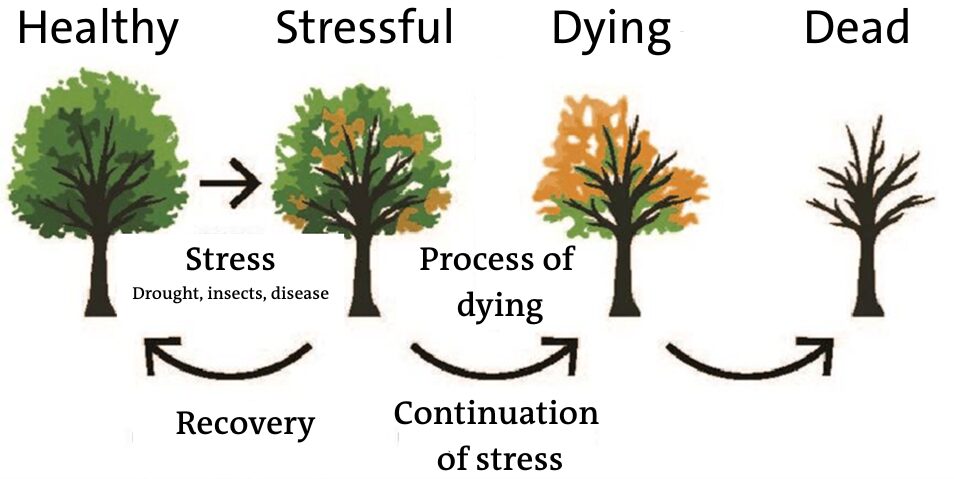

Crown defoliation (or crown thinning) indicates a lack of leaves or needles in the tree crown relative to a reference tree. The reference tree may have a lack of leaves or needles, i.e., a crown defoliation of up to 10%. Tree crown defoliation is one of the indicators of the vitality of forest trees, and also one of the criteria for selecting trees for sanitary felling. In Croatia, the selection of trees for sanitary felling includes all dry trees and trees with a degree of crown defoliation above 60%.
Data on the crown defoliation of pedunculate oak, silver fir, and common beech trees from bioindicative plots in the Republic of Croatia were collected from the database of the National Coordination Centre for the Assessment and Monitoring of the Influence of Atmospheric Pollution and Other Factors on Forest Ecosystems at the Croatian Forest Research Institute. Cases with crown defoliation degrees of 60% and higher, as well as 80% and higher, were analyzed, as was crown regeneration, i.e., the reduction of crown defoliation. The research results were presented by Prof. Dr. Damir Ugarković at lectures for forestry engineers in the Croatian Forestry Society in Vodice, Delnice, Karlovac, and Koprivnica, organized by the Chamber of Forestry and Wood Technology Engineers.
The analysis included a total of 7,975 trees, of which 1,182 were fir, 4,221 beech, and 2,572 oak, from the period between 1998 and 2023. Tree mortality was 7.2% for common silver fir, 2.16% for common beech, and 9.6% for pedunculate oak. The percentage of trees that regenerated their crown, i.e., reduced their crown defoliation to < 60%, was 17% for common silver fir, 4% for beech, and 12% for pedunculate oak. Common silver fir had the highest percentage of trees that regenerated their crown compared to beech and oak. The lowest percentage of crown regeneration < 60% was recorded in beech, while the lowest percentage of regeneration < 80% was observed in pedunculate oak.
Based on the research results, we believe that the percentage of crown defoliation as a criterion for the sanitary selection of trees should not be applied uniformly to all forest tree species (pedunculate oak, common beech, and common silver fir). When determining the crown defoliation criterion for sanitary felling, it is necessary to consider the ecological requirements and ecological valence of the species, the percentage of trees that have reduced crown defoliation, and the economic value of the wood.
Given that the main criterion for the selection of trees for sanitary felling is the percentage of crown defoliation, we recommend that the criterion be increased from 60% to 80% crown defoliation. An exception could be the criterion for the selection of pedunculate oak trees, which would remain unchanged.
