

The mean annual air temperature in the period from 2011 to 2023 increased by 1.0 to 1.4 °C, according to an analysis of measurements in Gospić, Gračac, and at Zavižan. Potential evapotranspiration for this period also showed a statistically significant increase compared to the reference series.
Climate is a complex, direct ecological factor described through various climatic elements, indices, and phenomena. Climate and soil are the two most significant habitat factors influencing the development and natural distribution of vegetation. Among climatic elements, air temperature, precipitation levels, insolation, air humidity, and wind are the most critical for forest vegetation.
Forest vegetation in the Dinarides region of Croatia is adapted to specific local climatic conditions. However, climate is not a constant ecological factor but a variable one. Climatic elements change over time, and these shifts reflect on the organisms within the ecosystem. The time factor is crucial in determining climate change, as a trend observed in one direction over a specific period may, with an extended observation series, prove to be part of natural climate fluctuations.
The main forest tree species in the Velebit area are the European beech (Fagus sylvatica), a species with a wide ecological amplitude, and the Silver fir (Abies alba), a species with a narrow ecological amplitude. Due to increasing warming and aridity, changes are expected in the ecological niche of the Silver fir in the Dinarides, with a predicted shift in its distribution toward higher altitudes.
We analyzed the trends of certain climatic elements and drought indices from 1981 to 2023 and compared the climate of the 2011–2023 period with the reference time series.
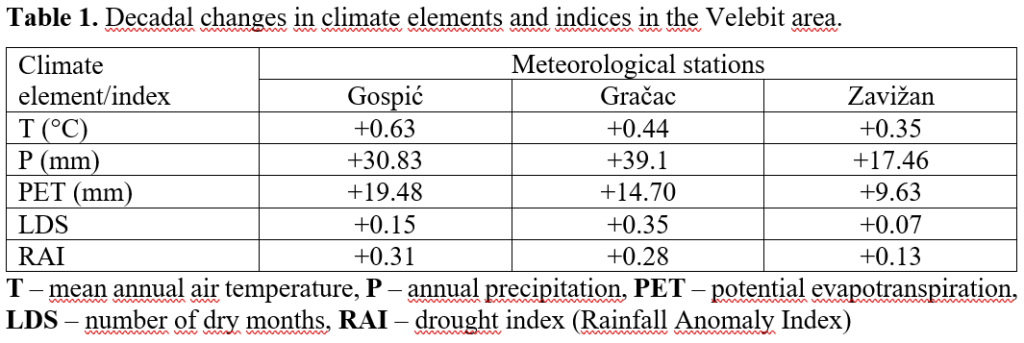
Trends for mean annual air temperatures and potential evapotranspiration are showing a statistically significant increase at all analyzed meteorological stations. Both the mean annual air temperatures and the amount of potential evapotranspiration for the 2011–2023 period have significantly increased compared to the reference series. The increase in air temperature ranged from 1.0 to 1.4 °C, while the increase in potential evapotranspiration ranged from 26.4 mm to 42.9 mm. Changes in precipitation amounts and the drought index (Rainfall Anomaly Index) were not statistically significant.
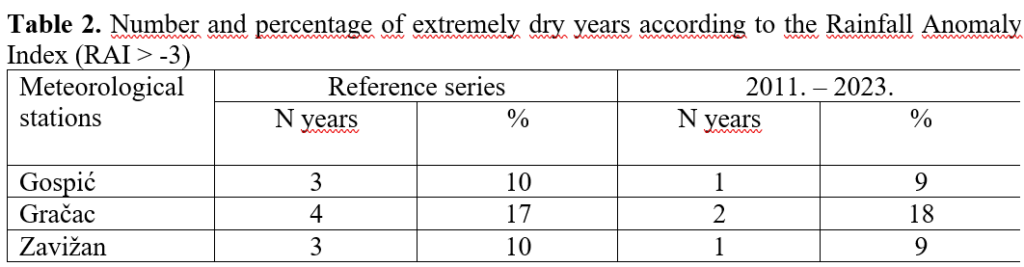
The increase in the number of dry months was statistically significant in the Gračac area. For the meteorological stations of Gospić and Gračac, located in the montane vegetation belt, the number of summer months with a soil water deficit increased from one (August) to two months (July and August). In the Zavižan area, located in the subalpine vegetation belt, the number of months with a water surplus increased by one month (July). However, this does not mean that more water is available to plants within the ecosystem, as June—previously a month with a soil water surplus—is no longer so.
Text: Prof. Dr. Damir Ugarković
