
It is recommended to improve forestry legislation by adopting a regulation on tree protection during forest harvesting operations and the compensation for damage to trees caused during timber skidding.

Silver fir (Abies alba Mill.) and common beech (Fagus sylvatica L.) are the most important commercial coniferous and broadleaved species in the Dinarides. Silver fir is the primary tree species in Croatian selection forests, covering an area of 200,000 ha. However, silver fir is also among the more vulnerable forest species due to various adverse biotic and abiotic factors, as well as its narrow ecological valence (amplitude). These factors result in serious tree decline, making sanitary felling and the extraction of forest wood products very frequent. Common beech is the most widespread forest species in the Republic of Croatia, present on nearly one million hectares. It occurs in even-aged, uneven-aged, and selection forests. Timber skidding can cause damage to trees and forest soil, which adversely affects diameter increment and the value of wood products, increases crown defoliation, and leads to long-term tree decline.
Fir More Damaged Than Beech
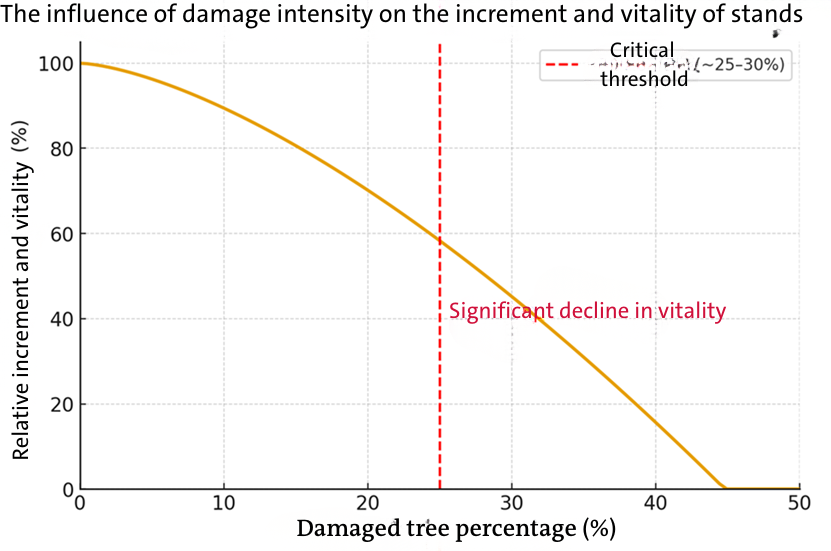
Damage and injuries to trees during initial timber skidding were analyzed. The aim of the analysis was to determine the correlation between the tree damage area and crown defoliation, as well as the relationship between tree damage and diameter increment. Multi-year data on crown defoliation of silver fir, diameter increment, and tree damage (injuries) caused by forest machinery were collected on experimental plots. For common beech, samples were collected at breast height ($d_{1.30}$) from both damaged and undamaged trees to analyze tree increment.
Damaged silver fir trees exhibited significantly higher crown defoliation compared to undamaged trees. Silver fir crown defoliation significantly correlated with the area and number of tree injuries, showing a positive but low correlation ($r = 0.31$). Damaged silver fir trees had a lower diameter increment than undamaged ones, with the decrease in increment being statistically significant in trees with a diameter of 30 to 50 cm. The damage area significantly influenced poorer tree vitality and shorter crown length. The average damage area for silver fir trees was 607 cm², with an average of 1.5 injuries per tree. The highest number of damaged trees was recorded in crown defoliation class 3a (60–80%) and in trees with a diameter above 50 cm. The largest damage area was recorded in defoliation class 3b (80–99%), also in trees exceeding a 50 cm diameter. According to damage area classes, the largest number of trees belonged to the first damage class (< 100 cm²). The highest number of damaged trees was recorded among dominant trees, while the largest damage area was recorded among co-dominant trees.
In common beech stands, 31–49% of trees sustained damage. Crown defoliation in damaged trees was significantly higher compared to trees without damage. Common beech trees with mechanical injuries from forest machinery showed lower increment, but the reduction was not statistically significant.
A Regulation is Required
Professor Damir Ugarković, PhD, presented the results of the analysis during lectures for forestry engineers at the Croatian Forestry Society in Vodice, Delnice, and Koprivnica, organized by the Chamber of Forestry and Wood Technology Engineers.
Given that forests and forest lands are of special interest to the Republic of Croatia and under special protection, it is recommended to improve forestry legislation to further define the conditions and methods of forest management. Currently, in Croatia, there is no regulation defining the maximum percentage of damaged residual trees in a forest stand. A regulation is needed to determine the maximum dimensions of tree damage, the maximum percentage of trees with significant damage, the method for compensating for lost increment and the reduced quality of future wood products, and measures for tree protection during forest harvesting operations.
